分类: C/C++
2010-11-11 16:32:19


 ~A()
~A() {
{  delete name;
 }class A{public: A()
 {
{ } A(int id,char *t_name) { _id=id; name=new char[strlen(t_name)+1]; strcpy(name,t_name); } A& operator =(A& a) { this->_id=a._id; int len=strlen(a.name); name=new char[len+1]; strcpy(name,a.name); return *this; } ~A() { cout<<"~destructor"<<endl; delete name; } int _id; char *name;};
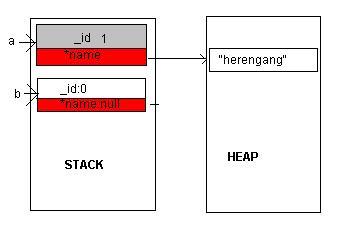
其内存分配如下:
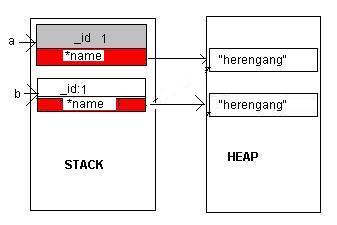
references:
类的深拷贝函数的重载
public class A
{
public:
...
A(A &a);//重载拷贝函数
A& operator=(A &b);//重载赋值函数
//或者 我们也可以这样重载赋值运算符 void operator=(A &a);即不返回任何值。如果这样的话,他将不支持客户代买中的链式赋值 ,例如a=b=c will be prohibited!
private:
int _id;
char *username;
}
A::A(A &a)
{
_id=a._id;
username=new char[strlen(a.username)+1];
if(username!=NULL)
strcpy(username,a.usernam);
}
A& A::operaton=(A &a)
{
if(this==&a)// 问:什么需要判断这个条件?(不是必须,只是优化而已)。答案:提示:考虑a=a这样的操作。
return *this;
if(username!=NULL)
delete username;
_id=a._id;
username=new char[strlen(a.username)+1];
if(username!=NULL)
strcpy(username,a.usernam);
return *this;
}
//另外一种写法:
void A::operation=(A &a)
{
if(username!=NULL)
delete username;
_id=a._id;
username=new char[strlen(a.username)+1];
if(username!=NULL)
strcpy(username,a.usernam);
}
其实,从上可以看出,赋值运算符和拷贝函数很相似。只不过赋值函数最好有返回值(进行链式赋值),返回也最好是对象的引用(为什么不是对象本身呢?note2有讲解), 而拷贝函数不需要返回任何。同时,赋值函数首先要释放掉对象自身的堆空间(如果需要的话),然后进行其他的operation.而拷贝函数不需要如此,因为对象此时还没有分配堆空间。
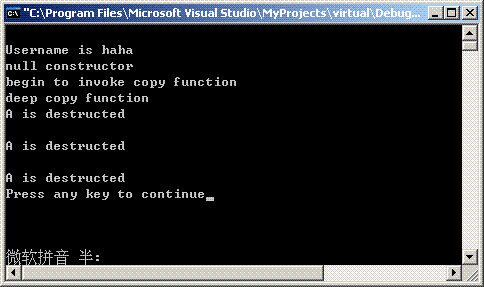
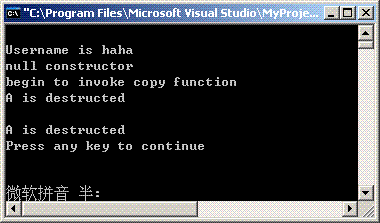
// virtual.cpp : Defines the entry point for the console application.//#include "stdafx.h"#include "string.h"#include "stdlib.h"#include "assert.h"class complex{public: int real; int virt;public: complex(){real=virt=0;} complex(int treal,int tvirt){real=treal;virt=tvirt;} complex operator+(const complex &x) { real+=x.real; virt+=x.virt; return *this; } complex operator=(const complex &x) { return complex(x.real,x.virt); }};class A{public: A(){m_username=NULL;printf("null constructor");} A(char *username) { int len; len=strlen(username); m_username=new char[len+1];//(char*)malloc(sizeof(len+1)); strcpy(m_username,username); printf("\nUsername is %s\n",m_username); } A(A &a); A operator=(A &b); int test(const int &x) { return x; } virtual ~A() { // if(m_username) { delete m_username; printf("\nA is destructed\n"); } }protected: char *m_username;};A::A(A &a){ int len=strlen(a.m_username); this->m_username=new char[len+2]; strcpy(m_username,a.m_username); strcat(m_username,"f"); printf("\ndeep copy function");}A A::operator=(A &b){ if(m_username) delete m_username; int len=strlen(b.m_username); this->m_username=new char[len+1]; strcpy(m_username,b.m_username);// printf("copied successfully!"); return *this;} class B:public A{public: B(char *username,char *password):A(username) { int len=strlen(password)+1; m_password=new char[len];//(char *)malloc(sizeof(len)); strcpy(m_password,password); printf("username:%s,password:%s\n",m_username,m_password); } ~B() { delete m_password; printf("B is destructed\n"); }protected: char *m_password;};int main(int argc, char* argv[]){// B b("herengang","982135");// A *a=&b;// delete a; A a("haha"); A b; printf("\nbegin to invoke copy function"); b=a;// printf("%d",b.test(2)); //complex x(1,3),y(1,4); //x=(x+y); //printf("%d,%d",x.real,x.virt); return 0;}1 重载赋值运算符返回结果为类对象的运行结果